


The Zone of Interest (Glazer, 2023)
Every so often, a film based on a literary work comes along that doesn’t so much as adapt it, but rather excavates it with a fine chisel to unearth truths that can be given even greater bearing when stripped away from a novelistic sheen. Such is the case with Jonathan Glazer’s treatment of the late Martin Amis’s penultimate novel The Zone of Interest, originally a work of historical fiction framed through various perspectives (most of them Nazi instigators and collaborators living in Auschwitz) during the tail end of World War II. Rather than taking Amis’s work at face value, Glazer recenters its historicity so that the real figures implicated in Auschwitz’s horrors—its commandant Rudolf Höss and wife Hedwig—return to the fore, no longer hidden by fabricated identities and now forced to bear the crushing weight of their sickening complicity through the cinematic prism of Glazer’s unrelenting exactitude.
Whereas Amis’s version of Höss (rechristened as Paul Doll in his book) was a mentally unstable portrait of grotesque grandstanding and rampant alcoholism, to the point where Hedwig’s literary substitute Hannah grew to loathe her husband and longed for Germany to lose the war, Glazer veers in the opposite direction, presenting to us a happy and stable marriage populated with healthy children, all living in a sickeningly Edenic household mere steps away from Auschwitz’s evils. In their otherwise mundane existence lies the profane: Rudolf receives official guests who come asking for approval to expand the crematorium’s capacity; Hedwig brags to her friends about the luxury goods she enjoys that have been confiscated from Jewish victims before their murders; their sons playfully dress in Nazi uniforms and secretly examine a handful of teeth in their beds, their source unknown. As the Höss’s tend the garden of their lives in addition to the sweeping garden of Hedwig’s designing, haunting sounds assault us from afar, from gunshots to shouts to cries and wails. Glazer preserves us from witnessing these atrocities firsthand, instead forcing us to accept an altogether different kind of atrocity: the atrocity of apathy. Moreover, he asks us: How black must a soul be to witness suffering of such magnitude without compunction?
By eliminating Amis’s plot completely and greatly lengthening a mere strand of the novel’s proclivities, Glazer minimalism does occasionally feel like it’s seeking a further complement, and it’s for this point only did I sometimes wish he had kept a little more from the book as a way of variegation. But the developments that are provided are still greatly effective, such as a visit from Hedwig’s mother that ends on a haunting chord and even Hedwig’s petulant rage over the prospect of leaving Auschwitz when she learns her husband is about to be transferred to a new post (for it’s hard not to assume much of her consternation stems from no longer being able to purloin the possessions of the dead). And there is also Glazer’s final coup de grâce, when visions of Auschwitz’s future bleed into the narrative during the one, single moment in which one of the Höss’ seems to feel a flicker of guilt.
Of the several risks he takes, this is the one that could have derailed the film completely, but it’s to his eternal credit that it hits the exact marks he intends. I left the cinema numbed, my arms clutching my body and my blood pumping ice as I tried and failed to comprehend an incomprehensible darkness, wrought by people who lived in it incomprehensibly. And The Zone of Interest, rather than being interested in comprehending it, instead shows us that there is no possible point of comprehension in the cinders of depravity. We bear witness to the totality of the truth in darkness.

American Fiction (Jefferson, 2023)
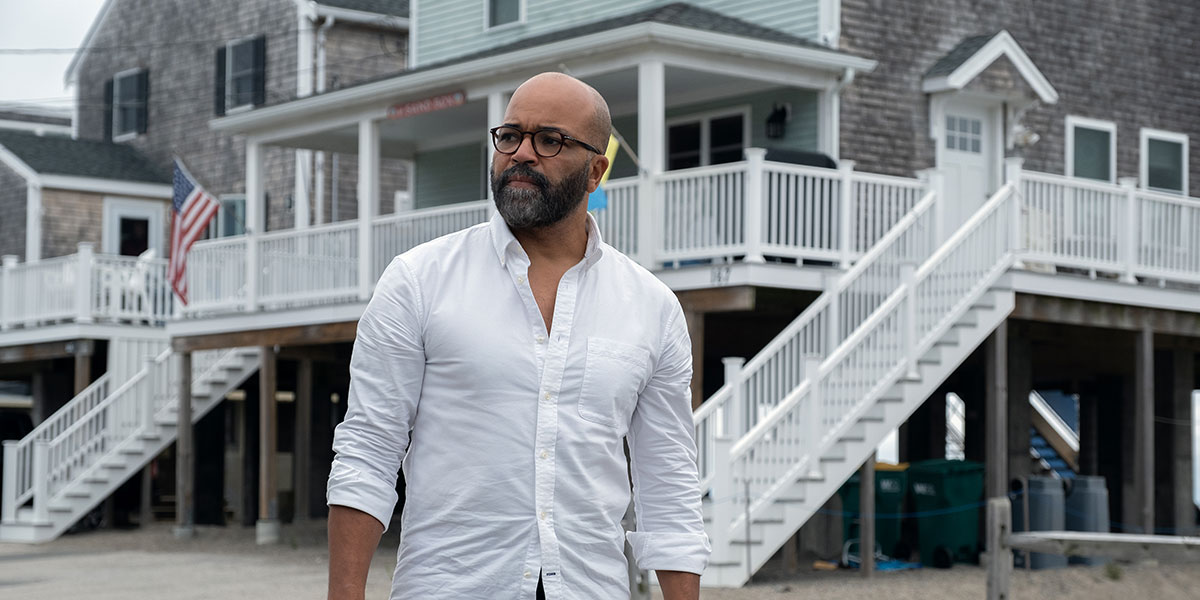
In his first foray into filmmaking, writer Cord Jefferson decided to take on something thought-provoking: An adaptation of Percival Everett’s little-known 2001 novel Erasure, in which a Black academic, disgusted with the state of the publishing industry and its willingness to cater to stereotypical Black representations, decides to pen the most racially hackneyed book he can muster and is aghast when it becomes an instant bestseller. It’s a simple but potent premise that lends itself well to the screen, as evidenced by the film winning the People’s Choice Award at the end of the festival. There is a truth enveloped in the absurdity to which an average moviegoer can lean into. It is easy to laugh heartily at the various quips and facial expressions donned by Jeffrey Weight as his character careens into pseudonymous celebrity status, all the while actively resisting the very foundations his celebrity rests upon. Toss in some familial drama involving a sibling’s untimely death, another sibling’s self-destructive lifestyle and a mother slowly being lost to the chasm of dementia, and there is certainly a lot here to chew on—but in a way that is, above all, digestible and agreeable. But maybe digestibility should not have been Jefferson’s chief prerogative.
After the film screening, Jefferson openly admitted to being influenced by films such as Spike Lee’s Bamboozled, Robert Downey Sr.’s Putney Swope, Robert Townsend’s Hollywood Shuffle and Robert Altman’s The Player, and indeed one can see some thematic unity between those works and what plays out in American Fiction. But what is missing is the sense of daring and provocativeness in the fabric of Jefferson’s filmmaking that Everett’s novel engenders, which made films like Bamboozled and Putney Swope so incredibly effective and unique in what they were satirizing. Jefferson’s debut behind the camera is efficient and workmanlike, moving easily from plot development to plot development without any major stumbles. But apart from the Altman-inspired ending (one of the major deviations from the novel), Jefferson’s journeyman vision is frustratingly unremarkable and safe in scope, unable to conjure enough memorable images or find sparks of visual creativity in the satire’s inherent outrageousness in a way that filmmakers like Spike Lee can do with ease. It’s an inoffensive kind of flatness that feels greatly at odds with the material, and certainly Laura Karpman’s smooth jazz score doesn’t help in making it pop, either. It ends up being entirely on the cast to give this project some semblance of panache, which certainly Jeffrey Wright and the supporting players try their best to do (and here I should shout-out Myra Lucretia Taylor’s warm and wise performance as housekeeper Lorraine, who shines brightest with her limited screentime and who is also given the film’s best subplot).
I will not deny that American Fiction’s viewing experience is pleasurable and that many a laugh can be shared. The jokes come freely and several of them are quite sharp, amplified even more by Wright’s superb delivery. But so much of this is really down to Everett’s original material. Jefferson’s attempt to bring it to life is fine enough, in the same way reheating leftovers from a few days ago is a fine enough last-minute meal. But in processing the film, one can’t help but feel that there was so much more potential left untapped to have it go the distance as a modern classic. And in saying so, perhaps Cord Jefferson should have waited a little longer to tackle it. Spending time to develop a more distinctive directorial voice could have made all the difference.

Riddle of Fire (Razooli, 2023)
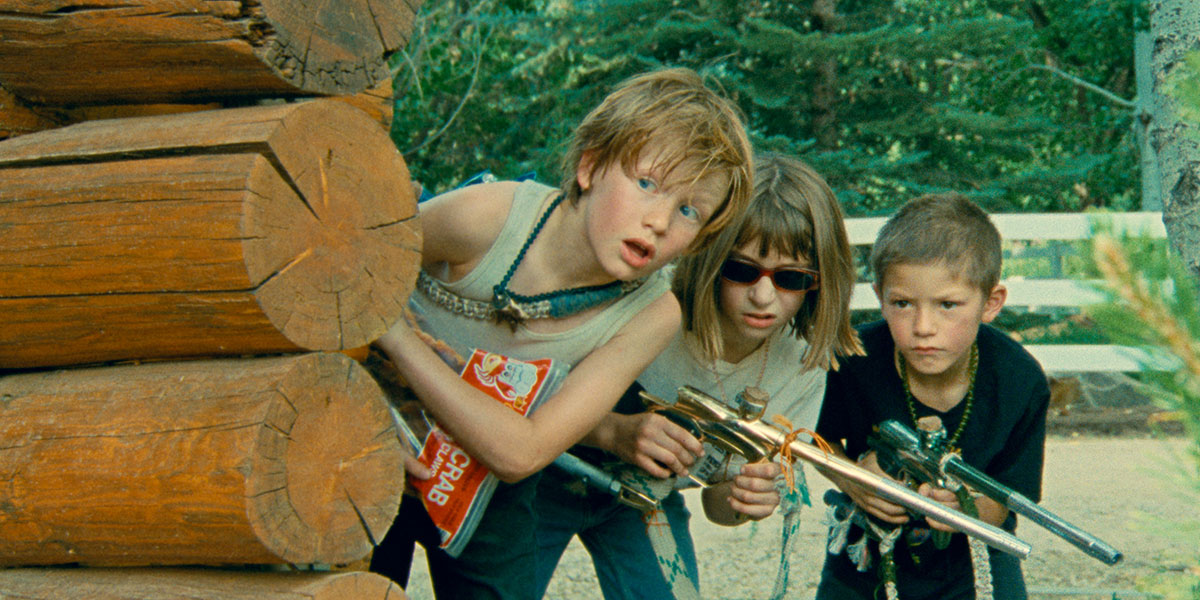
Shot on gossamer Kodak 16mm, Weston Razooli’s debut feature Riddle of Fire takes its audience on a precociously enchanting quest narrative headed by a trio of dirt bike-riding and paintball gun-toting scamps who become enmeshed in a variety of misadventures during a hazy summer’s day. When their sick mother tasks them with bringing her a blueberry pie in exchange for a coveted password that will allow them to play the video game console they’ve recently pilfered, Jodie, Alice and Hazel procure a pie recipe from the local baker, ready to make the delicious dessert themselves. But despite shoplifting most of the necessary ingredients at the nearby supermarket, they’re beaten to the last carton of speckled eggs by sinister poacher John Redrye (Charles Halford), who leads the misfits to the Enchanted Blade Gang coven and its head witch Anna-Freya Hollyhock (Lio Tipton). With unexpected help from Anna-Freya’s fairylike daughter Petal, the gang tail the coven to the mountains of Wyoming, ready to snatch the elusive eggs from Redrye’s clutches while Anna-Freya busies herself with trying to capture a strange and enigmatic creature. Multiple battles of wits ensue as everyone seeks their respective holy grails, culminating in a vibrant escapade of friendship, folklore, fantasy and fun that creatively crosses genres and tones with deftness of touch and fulness of heart.
Himself terming the film’s potpourri of genres as a “neo-fairytale,” Razooli does great work in evoking the way overactive childhood imaginations help to sensibly order the eccentric dictums of the real world, which all too easily can lurch from being ordinary to unknowable with the snap of a tree branch. Indeed, the film posits that the naïve innocence with which children lens the world around them, basking in shared codes and rituals together and finding unique interpretations of the mysteries surrounding them, is a necessary form of communal spiritualism that leads to its own kind of growth—even if there are still some moral kinks to be ironed out here and there. Shades of Wes Anderson’s works, which also revel in the fascinating worldbuilding capacities of jejune minds, can be felt in Razooli’s mise-en-scène, but Razooli is careful not to mould something that feels too indebted to other filmmakers or artists, instead finding a pleasing middle ground between artifice and realism that is never too familiar or expected.
Watching Razooli’s creations zigzag smalltown Wyoming’s dusty paths, haltingly reciting his dialogue with an infectious rehearsed amateurism and looking the most ragtag they can be, it’s difficult not to be charmed by such an effusive evocation of childhood joie de vivre, even when the film’s pacing occasionally stumbles or a creative facet threatens to overstay its welcome. It’s also difficult not to conjure back our own misty memories of boisterous childhood summers, where hot and sweaty days could yield a plethora of excitement, prompted by the most unexpected of sources. Such is the power of Riddle of Fire—well, that, and its ability to make you crave for your own slice of blueberry pie, of course.

 The Lonely Film Critic