
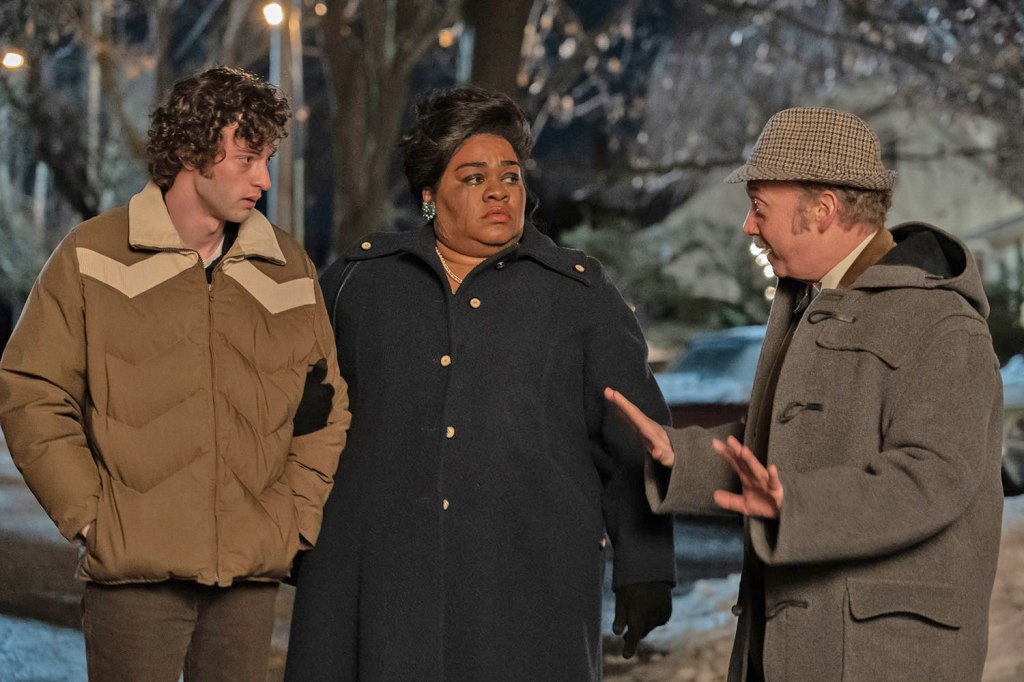

The Holdovers (Payne, 2023)
Dressed in the garb of a recently unearthed discovery from the 1970s, even with convincingly retro production bumpers and opening credits, Alexander Payne opts for safer waters with The Holdovers after his divisive venture into sci-fi absurdism with 2017’s Downsizing. Tapping into both a nostalgic place and time, reminiscent of Hal Ashby’s character studies and boarding school-set classics like The Paper Chase and Zero for Conduct, Payne whisks us back to the early days of the 1970s, with the Vietnam War still at the forefront of people’s minds and the counterculture rebelliousness of the 1960s still rubbing off on the young generation, including Angus Tully (newcomer Dominic Sessa), whose sharp intellect can’t hide an abrasive personality that yields him little in the way of friends during his time at Barton Academy. Said abrasiveness also puts him in the crosshairs of Barton’s misanthropic and lazy-eyed history professor Paul Hunham (Paul Giamatti), who hands out Ds and Fs with an almost gleeful disdain and gladly torments his pupils with extra homework assignments for their upcoming winter break. But neither Angus or Hunham will be taking a break from each other, as it turns out: at the last minute, Angus is forced to stay at Barton over the holidays while his mother honeymoons with her new partner, and Hunham is tasked with supervising the holdover students along with the school’s head cook Mary (Da’Vine Joy Randolph), who is still grieving the loss of her son in Vietnam.
With duelling personalities to spare and acerbic wit flowing as freely as a surreptitious bottle of whisky, Payne sets his stage very early on for a film that makes no bones about what it’s going to do or what it wants to be. And I suppose this can be a good or bad thing depending on your appreciation for Payne’s prior work, your tolerance for films that put more of a premium on looking to the past rather than innovating the form, and your own personal mood in the moment. While not the strongest of efforts from Payne, there is certainly a pleasing warmth to The Holdovers that is accentuated by his undeniable sense of craftsmanship and attention to the little details. While watching it, there is little doubt that it was made by a man who has refined his methods to a skilful degree: Every dissolve, every plot beat, every needle drop is laid down with exactness; the pacing is crisp without becoming too languid; the dialogue tartly rattles in the actors’ mouths, slick and germane to the period without crossing into overt preciousness. The tale itself is unelaborate, its emotional core centred more so than any unearned plot twists or detours, and there is a weariness and melancholy infused in the crevices between the prickly bantering of its lead characters that refuses to dissipate even when lessons are learned and hidden graces are unearthed. In short, Payne’s savviness as a filmmaker is on full display here, in ways both immediately evident and slyly suffused in the overall fabric, and this is easily commendable.
Perhaps what gives me some pause is the fact that, while The Holdovers is a strong display of Payne’s abilities as a technician and an incontrovertibly loving tribute to the era it’s emulating, it nevertheless feels too confined as a throwback to last beyond the immediacy of its pleasures. The very best of Payne’s work has felt fresh and almost ahead of their time (and even less successful ventures like Downsizing have, at least, a commendable sense of daring to them that makes them difficult to forget). The Holdovers, solid a film as it is, never quite answers the question of its existence other than to placate a more conservative subset of moviegoers who enjoy nothing more than wielding the phrase “They don’t make ‘em like that anymore” like a sanctified shield whenever they aren’t subjected to too much progressivism and too much contemporaneity. Lo and behold, Payne’s film will garner their approbation with ease, while filmgoers who do crave a more maverick approach will leave their seats a touch dissatisfied, even if they can respect Payne’s sturdiness at face value, as well as the impressive collection of performances from Giamatti, Randolph and Sessa.
It’s true, they don’t make films like The Holdovers anymore. More than anything, if they are made now at all, it is to scratch a filmmaker’s itch. To indulge a wistful memory of times gone by. I certainly don’t begrudge that longing of Payne’s, for the result is not bad by any means. But I also hope his next script ventures to take a few more risks to reap a higher level of rewards.


The Feeling That the Time for Doing Something Has Passed (Arnow, 2023)
As a fellow millennial who appreciates humour that lands in offbeat territory, Joanna Arnow’s feature debut holds an oddly pleasurable pull in its vignette-like structure that, in some ways, recalls the absurdist tableaus of Sweden’s Roy Andersson. Each segment depicts a moment in time in the life of Ann (Arnow, playing something of an autofictional version of herself), a 30-something New Yorker stuck between an uninspiring corporate job, a needy family and casual BDSM relationships with several men who seek sexual gratification from her submissiveness. As each scene cuts to the next, Arnow convincingly replicates the lurching inertia of Ann’s existence, where a sense of inevitable mundanity seems to follow her everywhere, even to her BDSM hookups. The humour derives from Arnow’s affectless deadpanning and willingness to delve into the inherent ridiculousness that speckles the corners of her day-to-day grind, whether it be the miniature trial of emptying a plastic package of pre-prepared stew into a bowl for dinner or putting on a pig costume to fulfill a man’s fetishistic fantasies.
Arnow’s observances are acute and random, but always flavourful without being meanspirited. Her depiction of Ann’s BDSM forays, for instance, are hilarious without ever losing sight of Ann’s agency as a willing and active participant, and there is something of a touching sincerity in the way her sexual encounters give her a sense of fulfillment that her job and family otherwise cannot—even if not all the men she meets deserve her attention. There is also much fun to be had with the vignettes involving Ann’s parents, mostly because they are played by Arnow’s own parents and hearken a little to the short features Martin Scorsese made with his own parents several decades earlier. Their lack of experience behind the camera adds another layer of non sequitur to the diegesis, but in a way that finds harmony with Arnow’s purpose.
Situational in scope, The Feeling That the Time for Doing Something Has Passed nevertheless feels almost uncomfortably relatable at times for anyone who has felt trapped in a set and restless pattern, living unremarkably from one minute to the next, but also quietly striving for tiny moments of grace and development when the opportunities arise. And through Arnow’s inventive framing and malleable depiction of time, we gradually see Ann making efforts to climb out of her rut and take on exciting changes, lending the film an unusual poignancy on top of its gentle goofiness. While the film’s overt deliberateness will not be for everyone, Arnow’s cinematic voice is excitingly distinct and one that I, personally, will be looking forward to seeing again.


Spirit of Ecstasy (Klotz, 2023)
From the very first scenes of Spirit of Ecstasy, there is an immediate sense of propulsion that synergizes directly with its protagonist. We see a shadowy figure glide through the streets of Paris on their motorbike and then, with hardly any hesitation, break the window of an expensive tailors and strip a windowfront mannequin of a suit. The theft is successful save for a painful shard of glass that lodges in their chest, but the glass is removed and the wound bandaged. It’s a minor inconvenience, for the suit must be donned the next day for an important job interview wherein our mysterious thief Jeanne Francoeur (Claire Pommet) visits a high-ranking firm in the hopes of becoming their new financial analyst (or “quant”). With their closely-cropped hair and aversion to styling themselves in accordance with conventional gender norms, Jeanne’s non-binary status is affirmed immediately and unambiguously. Later on, in discussing their identity, they reveal that they wish to be neutral in the same way that numbers are. “Is the number 7 masculine or feminine?” they quiz a sleek executive (Sofiane Zermani), who has no response to give. And this is Jeanne to a tee: A person who wishes to be judged on their talents and capabilities rather than how they choose to outwardly present themselves.
Héléna Klotz’s portrait of Jeanne is a good mix of kineticism and tenderness as we see them almost shapeshift their persona depending on their surroundings, and Klotz ably shapeshifts her film’s tones in turn. When Jeanne is trying to climb the rungs of the financial world, the film takes on a cool and almost ruthless sheen and thrust to match the calculating minds involved. And then when things shift to Jeanne’s domestic life and the reintroduction of their former boyfriend (Niels Schneider), who comes back some time after their messy separation with a degree of remorse and self-reflection, we are given the chance to see Jeanne’s softer and more vulnerable side as a counterpoint to their hard-edged ambitiousness.
What is most refreshing, ultimately, is that Jeanne’s non-binary status is taken at face value and doesn’t need to be turned into a spectacle or source of misery as a way of imparting moral lessons or learning opportunities for the audience. While it provokes a bit of discussion during the film from time to time, it is ultimately left as a relatively unremarkable aspect of Jeanne because in the end it’s their brilliance that matters. It’s their drive and hunger for progress—their thirst for a challenge to sink their teeth into. Jeanne’s suits cover their body, but the narrative is completely driven by their fierce intelligence and heart, and certainly, the film does become a little more mundane and straightforward when you realize that that is its aim. But not in a bad sense, or a frustrating one. Even when there are a few clichés and predictable developments that keep the film from becoming a better one, at the very least Klotz is able to stay away from the more egregious ones that she could have gone for. And Claire Pommet, so confident and cool in her acting debut, helps seal the deal in spades.

 The Lonely Film Critic