As technologies change and consumers continue to both demand and seek out higher and higher resolutions and fidelities for their media consumption, making a film on a Sony Ericsson cellphone that’s almost 20 years old and long-since obsolete certainly seems to be asking for trouble. And not only that, but then to go and make the film 3 hours long and narratively sparse? Georgian filmmaker Alexandre Koberidze does so with his third feature Dry Leaf, which is a true litmus test in terms of the trust an artist seeks from their audience. There are those who will walk away quickly, sharing their heads in disbelief and grumbling about wasted time—perhaps throwing in a few invectives against pretentiousness. But there will be those who will meet Koberidze on the terms he sets out and find something almost miraculous about the journey Dry Leaf takes them on. I count myself among the latter group.
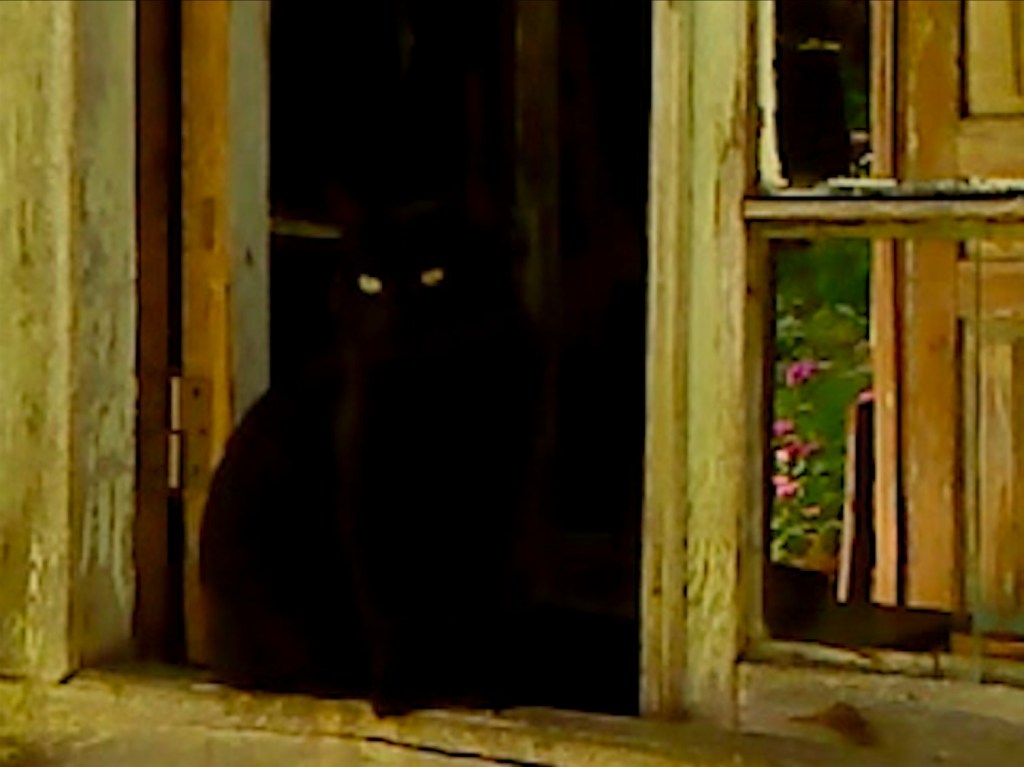
I will be forthright and admit that Dry Leaf takes a bit of time to adjust to. Like a YouTube video from the early aughts viewed on a shaky dial-up connection, the filmic image is pixelated and compressed beyond belief. There are almost no fine details to look at and admire. Faces and bodies devolve into indistinguishable bloblets in wide shots. Foliage is reminiscent of blocky Minecraft backgrounds. In one memorable moment, a black cat blends seamlessly into a dark window, invisible until its golden eyes suddenly reveal themselves, floating in seeming nothingness for a split second. The pixels themselves throb and strobe on the screen like they are infused with invisible blood—as if, in fact, the projector itself is in danger of breaking down and can barely contain the crudeness of the visual form its displaying.
As someone who purchased his first 4K TV nearly a year ago, being taken back to the lo-fi quality of media consumed in my youth was jarring. But after a while, as I settled into the film’s gentle rhythms and trained my eyes to refocus, there was an unusual beauty to the frames. As its central character Irakli (played by Koberidze’s own father) travels throughout rural Georgia, stopping at various football fields trying to find his missing daughter after she left behind a cryptic letter, an impressionistic, almost painterly quality emerges from the low fidelity and distortion. A tranquility emanates from the softness of the image, matching the peace of the natural world that Irakli is surrounded by, even when the heart of his quest is couched in parental worry. Coupled with the predictable pattern of his search, which is rarely interrupted by alternate outcomes, Koberidze invites the viewer not to concern themselves too much with narrative fulfillment, but to instead invest themselves with finding new ways of seeing. And, in so doing, they can challenge their preconceived notions and biases about what a film should look like in order to be called “great.”
Dry Leaf does place a high degree of demand on its viewer, but in truth, many of our greatest films do the same thing, asking them to reconsider their perceptions and to think more deeply about what the cinematic artform is capable of doing—and why. Alexandre Koberidze could have easily shot his film on the latest, most expensive film camera on the market, but instead he whipped out an ancient phone and did the opposite. He did so to prove that beautiful, soul-stirring art is not wholly reliant on the progress of technological innovation, but what is beyond it. The boundaries of that art are limitless. Dry Leaf has a beauty in the way it approaches the life around it and in how it welcomes us to pause and appreciate it as well. And to me, that is more beautiful than the cleanest, sharpest resolution we have on the market today.

Dry Leaf had its North American premiere at TIFF in the Wavelengths programme on September 7, 2025.
 The Lonely Film Critic