
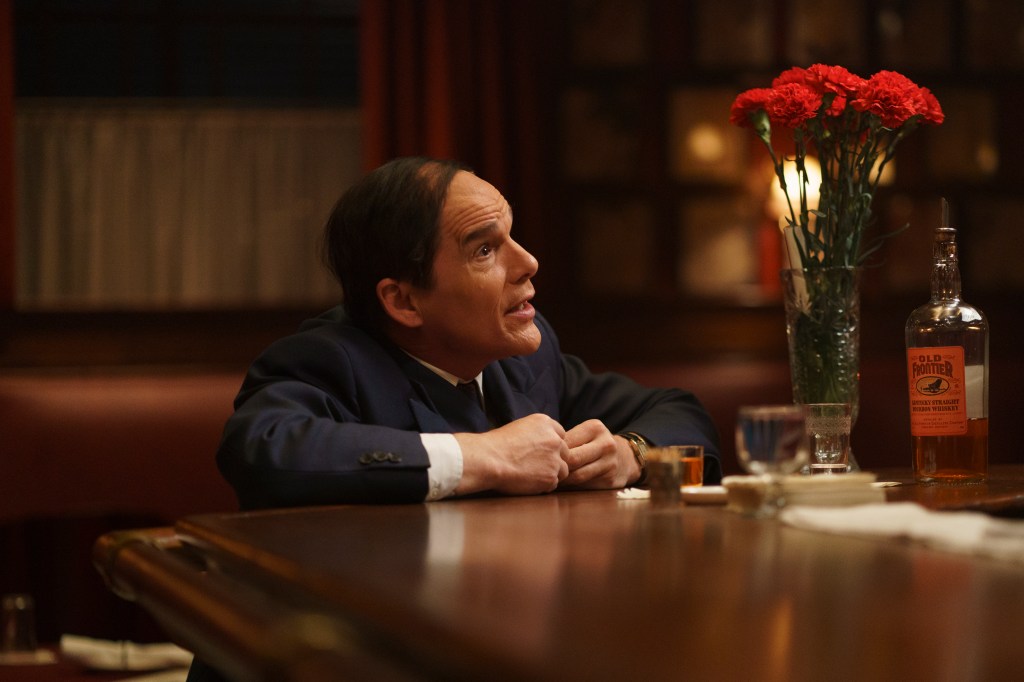
Blue Moon is, in some ways, a story about halves and dualities. As the film opens, two seemingly contradictory quotes flash over the screen: One by acclaimed lyricist Oscar Hammerstein II, describing songwriter Lorenz Hart as “alert and dynamic and fun to be around.” The second by cabaret singer Mabel Mercer, however, paints a stark contrast: “He was the saddest man I ever knew.” Mercer’s quote reaches its full potency quite quickly as the prologue reveals Hart’s tragic fate: dying at only 48 years old from pneumonia after being found drunk and unconscious in a gutter on a rainy night. It’s a curious decision for Richard Linklater to reveal his protagonist’s sad end at the starting gate, but when the film is seen in its entirety, it turns out to be a shrewd one.
The reason for this is in how we witness a man both marked for greatness and also marked for death live out one night of his life: namely, at New York’s venerable restaurant Sardi’s, a perpetual mingling spot for society’s rich and famous, whose caricatured faces adorn its wood-panelled walls. Set just after the premiere of Oklahoma!, the first of many successful collaborations between Hart’s former writing partner Richard Rodgers and his new associate Oscar Hammerstein, Blue Moon tracks the garrulous and diminutive Hart (played with great verve by Ethan Hawke) as he regales the Sardi’s staff with such things as his personal philosophy on the culture and art of the war-torn present, anecdotes about how some of his famous songs came to be, and, most prominently, his current infatuation with a college student 20 years his junior, with whom he has been corresponding with via letters—and who he will be meeting at Sardi’s at the same time Rodgers and Hammerstein arrive to celebrate their new musical’s success.
Many worlds seem to close in on Hart simultaneously in this evening that Linklater and screenwriter Robert Kaplow imagine for him, and it’s a testament to them that the constraints of this single location do not feel overbearing or too stagey, but rather a suitable externalization of Hart’s many insecurities and vices that, try as he may, he continuously wants to paper over with the gift of his gab. Sardi’s is a place that Hart can lay low in, but not a place to hide from the world, or his failures. Hence why his eventual reunion with his former partner Rodgers (Andrew Scott) is tinged with plaintive resignation, even as Rodgers pitches the idea to revive an old project of theirs with new songs. Hence why his eventual meeting with his young sweetheart Elizabeth (Margaret Qualley) is bound to end in heartache, as it becomes increasingly clear Elizabeth’s affection for Hart is merely platonic and not erotic.
Halves and dualities. Lives lived in reverse and the inverse. Blue Moon positively aches with the clash of the private and public lives of Lorenz Hart and a genius that petered out through the ravages of depression and alcoholism, despite Hart’s valiant efforts to assure those around him that his grand return was imminent; that he still had so much more to contribute to America’s artistic legacy. The spotlight on Hart’s tragic inability to save himself from his fate makes Blue Moon something of a dispiriting watch, but Linklater’s assured vision and resolution to honour this man whose legacy became overshadowed by the Rodgers and Hammerstein partnership makes it gratifying in spite of it.
There are a few distracting imperfections, such as the painfully obvious tricks to dwarf Hawke to Hart’s actual height, and some grating winks and nudges that exist only as Easter eggs for a knowing audience to smile over (among them a cameo from a child Stephen Sondheim, who pops up to dismiss Hart’s songwriting abilities before promptly exiting stage left). But what I really appreciated above all was the film’s honesty in paying tribute to Lorenz Hart without downplaying his contradictions. It does pity him, and certainly pities the flaws that hastened him to his early grave. But above all that, it is proud of what he managed to accomplish, of his complex artistic prowess, and the indelible mark he continues to have in the echelon of American song even today.

 The Lonely Film Critic