
“Where do you think we go?”
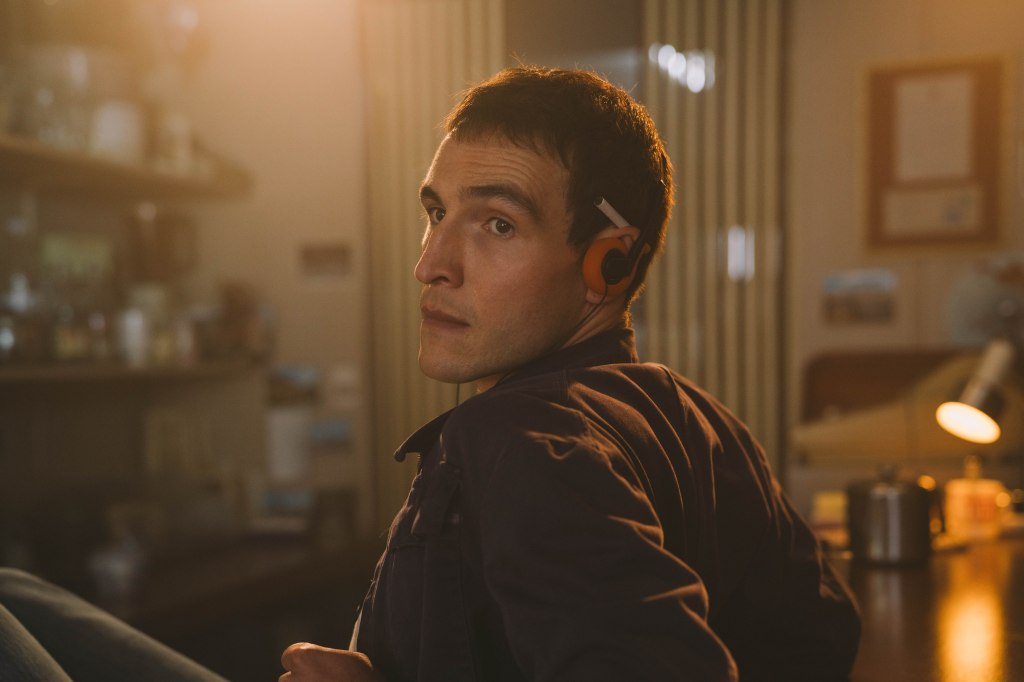
It’s a small question, asked with innocent inquisitiveness by soft-spoken Tiny (Jack Wolfe) to his older friend Beau (Éanna Hardwicke) one night as they lie together. Its metaphysical implications do not immediately register with Beau until Tiny clarifies:
“If we come from somewhere else, maybe we’re going somewhere else.”
“We come from the same place as everyone else. We’re just stuck here being what we are. That’s it.”
It is a brief, unsurprising response from the unsentimental Beau, who swats away any suggestion that the shared queerness between himself and Tiny might destine them for an afterlife distinct from that of heterosexuals. His unwillingness to engage may initially seem callous, until Tiny turns on his side to sleep and Beau notices the blotchy lesion on his neck. Tiny has his own reasons to contemplate the afterlife; Beau has his reasons to fear it. They are gay men living in London at the tail end of the 1980s, after all. Sickness and death lurk unbidden and unwavering, ready to strike with impunity, heedless of the relationships they might leave in tatters as ignorance and fear take root.
David Turpin’s debut feature, Ancestors, excavates the remnants of a decade marked by ruthless loss, when the AIDS crisis stole a generation of men from the world. The acronym itself is never uttered, but as Turpin’s intentions gradually come into sharper relief, it becomes clear that naming this particular grief would be beside the point. Any attempt to make explicit an era and an experience that can no longer be fully substantiated by those we lost risks introducing a certain falseness. Turpin’s solution, instead, is to honour this vanished world through the fantastical, the mythical, the unreal. The dead were dreamers; let them dream. Let us usher them back with grace, and with that same grace, serve as psychopomps to guide them once more toward the realm of the dead.
Turpin himself describes Ancestors as a kind of séance, and the metaphor becomes increasingly apt as the film unfolds. Its characters—Beau and Tiny especially—are never quite fully tangible or knowable. They hover at the periphery of comprehension, like wraiths who can be glimpsed but never completely discerned. Then there is the otherworldly Gloria, played with enigmatic beauty by Christina Hendricks: a literal psychopomp within Turpin’s cinematic expiation. Her presence invokes both the distinctly queer mythologizing of the Hollywood star machine and the world of Polari, the coded slang once adopted by gay men as a means of discreet communication. “Gloria,” after all, is the Polari equivalent of “God.” In Beau’s dreams and visions, Gloria becomes a kind of guiding star, her significance initially elusive until the layers of Turpin’s vision gradually reveal the importance of her presence.
Much of the experience of watching Ancestors is like this: inhabiting the dreamscape of an era eroded by time and absence, absorbing its visions and slowly drawing back as disparate pieces click into place and their emotional weight emerges into the light. Occasionally, however, the film retreats too far into the cerebral and inaccessible, and one longs—even briefly—for a more immediate connection. There is a desire to bang on Turpin’s door and demand to feel these characters more fully: to mourn them, to love them, to know them.
Yet this cruel inaccessibility is also essential to Ancestors. Its characters remain elusive because we, too, are left with the perpetual cruelty of all that AIDS stole and annihilated. The film’s emotional distance is perhaps analogous to the necessary cruelty of Beau’s abrupt answer to Tiny’s question. It is cruel in its refusal to entertain Tiny’s curious impulse to dream, but necessary, at least in Beau’s mind, because a man approaching the end of his life cannot afford to be disappointed by what awaits him. The dreams, perhaps, are best left to those who are still here to dream them.

Ancestors had its world premiere at TIFF in the Discovery programme on Saturday, September 12, 2026.
 The Lonely Film Critic