
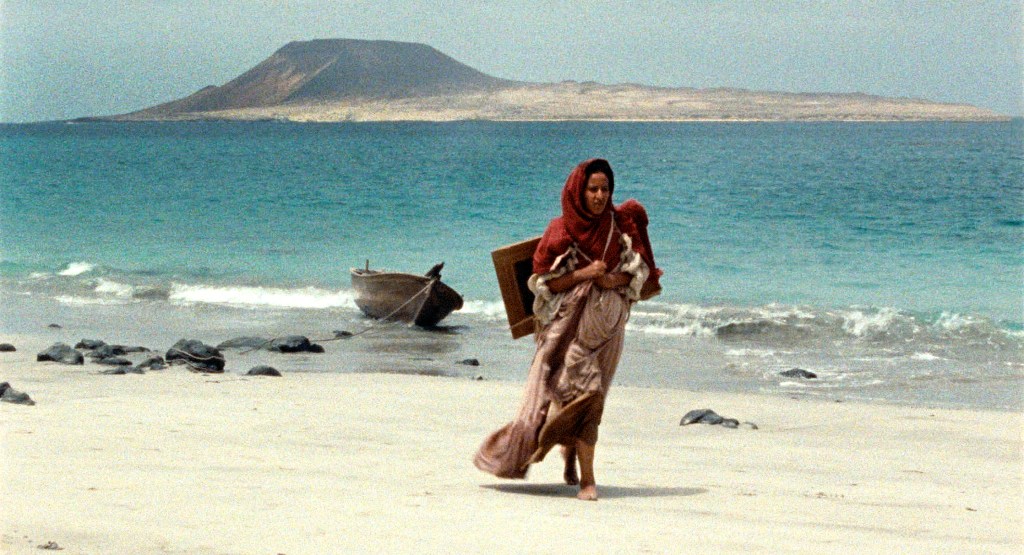
In its lean 80-minute runtime, The Fortunate Isles covers considerable ground. On its surface, the film is steeped in the colonial history of the Canary Islands, a subject that has received comparatively little cinematic attention. The violence of subjugation and enslavement inflicted by the Crown of Castile upon the Indigenous Guanche peoples is distilled into the story of a decrepit marquis and his pregnant slave, Fátima, who preside over one of the islands’ settlements and control its scant water supply. Directors Helena Girón and Samuel Delgado lay bare the conflicts of their desolate, weather-beaten milieu with minimal dialogue and a profound trust in their actors, who convey much of what remains unsaid through the simple physicality of carrying a basket, clutching a chicken bone, or unfurling a fishing net. The film privileges tactility and close observation, gradually revealing its microcosms and networks of allegiance with quiet assiduity while foregrounding the environmental forces that shape so much of what occurs.
And much does occur, accumulating like pebbles along a shoreline. Fátima discovers an ornate mirror shimmering in the water and is transfixed by the reflection staring back at her. The islanders’ anger over their denial of clean water mounts, while Fátima secretly drinks from a private supply of her own. The marquis’s son, visiting unexpectedly from a neighbouring island, arrives with even more unexpected news. Then, almost inevitably, the long-anticipated insurrection arrives, leaving Fátima master not only of her own destiny but of those of her unborn child and her fellow islanders. Fateful decisions must be made, but at what cost?
There is a stateliness to Girón and Delgado’s filmmaking that aligns beautifully with the inner grace of their protagonist, a woman caught between the colonial powers she is forced to serve and her conscience, which compels her to help those who depend upon her. The painterly mise-en-scène gorgeously evokes a vanished era while allowing tiny echoes of the contemporary to seep through, suggesting that the vicious mechanisms of imperialism have never ceased reverberating across the centuries. Fears of resource scarcity and the capitalist impulse to control the very necessities upon which societies depend, after all, are hardly relics of the past.
The Fortunate Isles shoulders these concerns impressively despite its pared-down narrative. Less successful is its struggle to sustain an emotional throughline. The film’s first half brims with promise, establishing a richly suggestive world and a compelling moral predicament for Fátima. But the quest she undertakes in the second half is insufficiently developed to support the weight placed upon its conclusion, which draws deliberately on the tradition of saints’ hagiographies. The ending gestures toward a larger spiritual and allegorical significance without giving Fátima’s transformation enough dramatic grounding to fully earn it.
The result falls just short of achieving the film’s considerable ambitions. Even so, Girón and Delgado demonstrate an exciting command of visual storytelling, possessing an instinctive understanding of how landscape, gesture, silence, and texture can communicate what dialogue cannot. If The Fortunate Isles occasionally struggles to bring its narrative and emotional threads fully together, its formal confidence suggests that these filmmakers have only begun to explore what they can do with the camera—and that their future collaborations will be worth watching closely.

The Fortunate Isles had its world premiere at TIFF in the Discovery programme on Tuesday, September 15, 2026.

