
Fifty years after her landmark cinéma vérité masterpiece Harlan County U.S.A., which offered a singular perspective on the inner workings of a coal miners’ strike in Kentucky, and 36 years after the equally influential American Dream, which chronicled a strike at a meatpacking plant in Minnesota, esteemed documentarian Barbara Kopple returns to her roots of excavating the American labour movement with Union Town. The setting has shifted to New York City, but more importantly, the concerns of labour have evolved alongside the insidious consequences of e-commerce and the people whose work sustains a modern society increasingly organized around speed, convenience, and instant access.
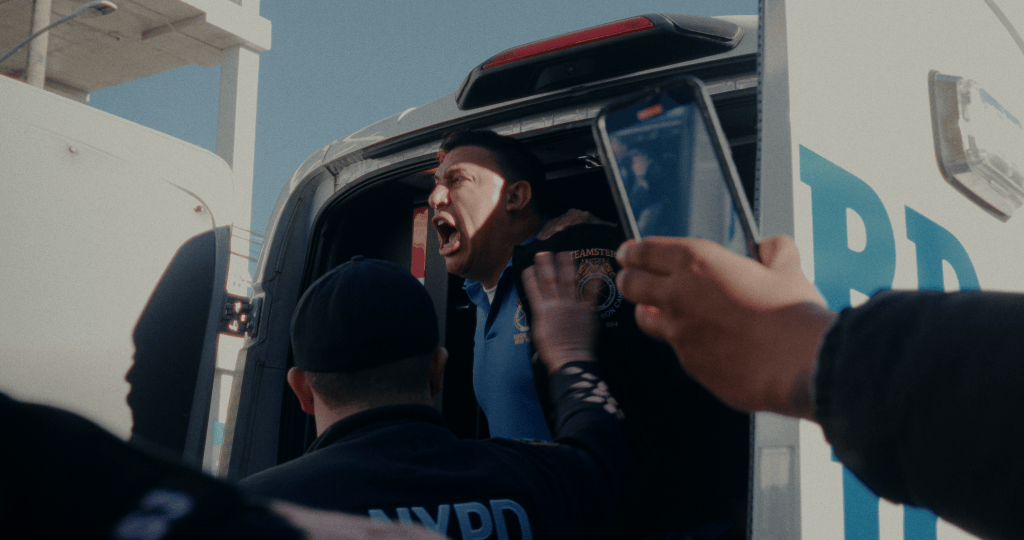
I’m happy to report that, at 80, Kopple has lost none of her edge or flair. Within the first few minutes, she establishes the film’s central concerns by filming a Teamsters meeting outside a UPS delivery facility in Queens. It is one of many worker rallies throughout the film, where collective solidarity and the rhetoric of persuasion converge against the injustices of corporate power. UPS workers, plagued by long, exhausting shifts hauling heavy packages to doorsteps, driving vans without air conditioning, and, in some cases, sleeping in their cars to cover split shifts, demand a fairer contract—one that guarantees a livable wage and more humane working conditions. Through tight editing and her signature unobtrusive approach to letting events unfold before her camera, Kopple focuses on their struggle to be heard, finding compelling subjects whose sobering personal histories give an intimate face to the broader fight for workplace dignity.
But Kopple has other fish to fry. We are also introduced to workers at a nearby Amazon warehouse, where a modern David-and-Goliath confrontation takes shape as employees seek to join the Teamsters and unionize for the first time. Kopple documents Amazon’s painstaking efforts to suppress even discussion of unionization among its workforce, before following the workers as they enlist the Teamsters’ support and organize a strike against the punishing conditions under which they work. The battle is familiar, but Kopple’s proximity to the workers keeps it from feeling abstract: the fight over collective bargaining becomes inseparable from the question of who gets to exercise power over their own working lives.
To complete the film’s triptych, and in its most emotionally devastating passages, Kopple follows the Los Deliveristas of the Workers Justice Project and their tireless advocacy on behalf of New York’s predominantly migrant app-based delivery workforce. These workers face the obvious dangers of navigating the city’s congested streets in all manner of weather, alongside unjust app deactivations, wage theft, and the precariousness inherent in algorithmically managed employment. Their plight is harrowing, and at every turn Kopple insists on foregrounding their humanity in a climate that has persistently sought to reduce them to data points and disposable labour. Perhaps the film’s most devastating sequence comes when an aunt grieves the loss of her young nephew, who is struck and killed by a car while making a delivery. The senselessness of the tragedy, coupled with the extraordinary sensitivity with which Kopple documents the family’s grief, clarifies the stakes of a new gig economy—and of a twenty-first-century labour system increasingly governed by the increased use and abuse of AI, surveillance, and digitization.
There is still much that remains new, unknown, and unresolved about this evolving form of labour, and Kopple inevitably cannot fill every blank space on this particular canvas. Her decision to pursue a three-pronged approach also creates a difficult balancing act. Each of these struggles contains enough complexity to sustain a documentary of its own, making it impossible for Union Town to give every nuance equal weight within its relatively compact running time. Yet the breadth of the film ultimately complements its central argument. Across three years, Kopple assembles a portrait of the power and beauty of grassroots organization, documenting significant victories born from workers’ resilient insistence that their dignity and rights be respected.
Union Town is, above all, a fulfilling testament to that tirelessness. And few filmmakers are better equipped than Barbara Kopple to honour these workers with such empathy, urgency, and an abiding faith in the power of collective action.

Union Town had its North American premiere at TIFF in the TIFF Docs programme on Tuesday, September 15, 2026.

